In this article
The most consequential part of a feature description may be a short word: if, after, only, unless, may. These words connect an attractive outcome to a condition, a sequence, a boundary, or uncertainty. They are easy to lose when a sentence becomes a headline or a note. Reading them carefully is a language task before it is a product task.
The Corpay Prepaid public page includes qualifications alongside feature descriptions and directs readers to the cardholder agreement for details. This article does not turn those public descriptions into an account-level promise. It shows how to preserve the structure of any conditional statement while you look for the relevant program documents.
“If” makes a branch
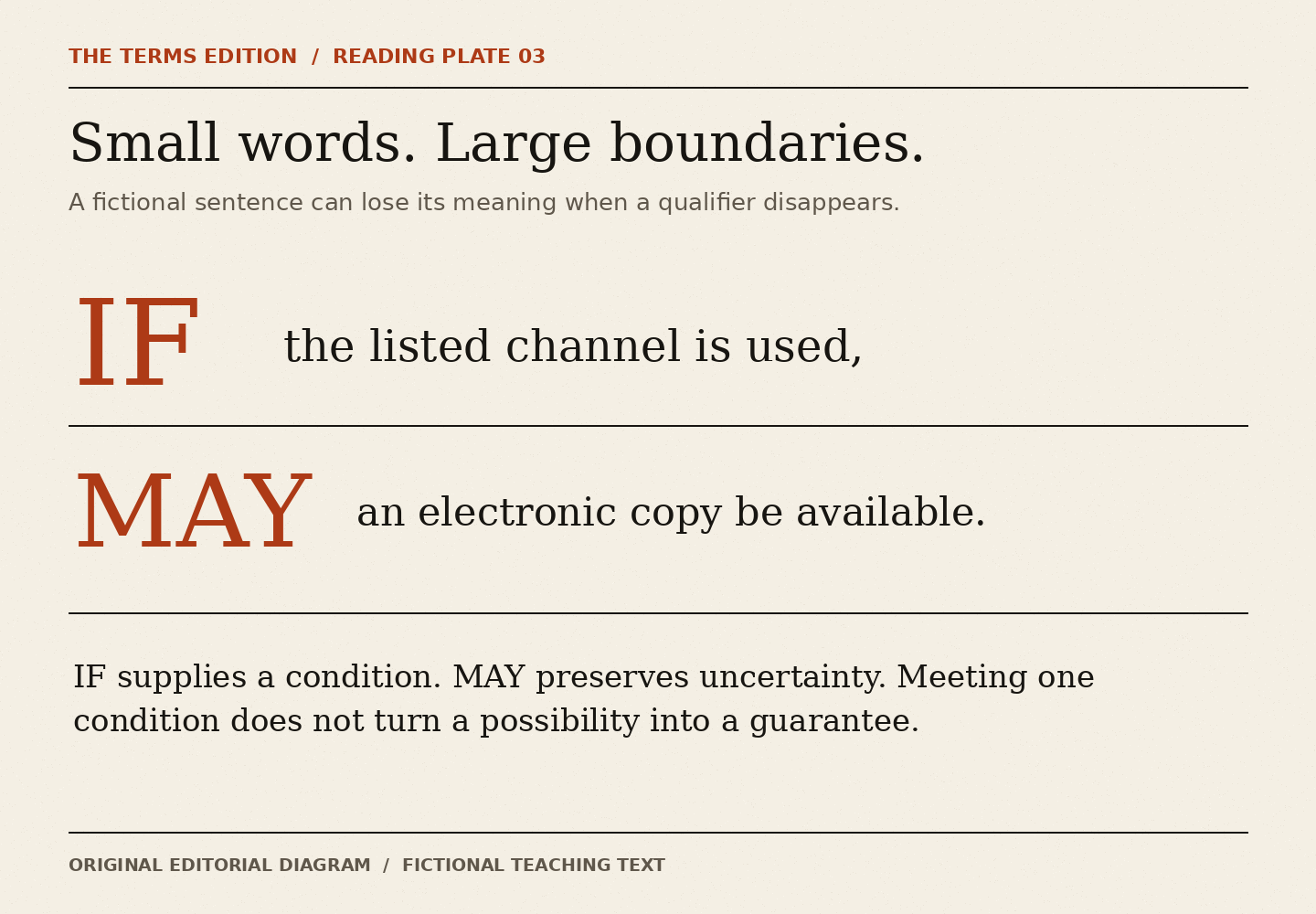
Here is a fictional teaching sentence, not a provider term: “If the document request uses the listed channel, an electronic copy may be available.” It contains two ideas that must not be collapsed. The listed channel is a condition. Availability is expressed as a possibility. Satisfying the first part does not allow the reader to rewrite the second as a guarantee.
A plain-language note can retain both: “This sentence links possible electronic availability to a listed request channel.” That summary is useful even before you know what the channel is. The unanswered questions are visible: where is the channel defined, and does another section explain availability? The note does not need to guess either answer.
A common mistake is to reverse an implication. If a document says that a condition is needed for a feature, it does not necessarily say that meeting the condition is sufficient for the feature. Other conditions may appear elsewhere. Conversely, a statement about one route does not automatically exclude every other route unless the wording says so. Do not complete the logic from intuition.
“After” gives order, not necessarily duration
In a fictional example, “A document becomes visible after review” identifies a sequence. It does not state how long review takes, when it starts, or whether it has been completed in a particular case. A reader who summarizes this as “the document will appear soon” has added both a prediction and a vague time promise.
Use a sequence sketch with two labeled events and an arrow between them. Then place a question mark where duration would go. This makes the missing information apparent without inventing a calendar. If another passage supplies a period, preserve the event that starts it and the words used to describe the period. This magazine’s focus is understanding the sentence, not planning around account timing.
Some sentences use “after” conversationally while others use it in a defined process. Read the surrounding section before treating it as a formal trigger. If the text remains unclear, quote the short phrase in your own private notes and ask which event the writer means. Do not replace it with an event that happens to be easier to observe.
“Only” tells you where to look for a boundary
Compare two fictional statements: “The service is available through the portal” and “The service is available only through the portal.” The second contains an exclusion that the first does not express. The first identifies a route; it does not, by itself, establish exclusivity. This difference is small in print and large in a summary.
“Only” can attach to different parts of a sentence. “Only registered readers can request the document” narrows the audience. “Readers can request only the current document” narrows the object. “Readers can request the document only during the stated period” narrows the timing. Underlining the word without identifying what it modifies is not enough.
Try moving the boundary into a separate note: audience restriction, object restriction, channel restriction, or period restriction. If two readings remain plausible, preserve both as interpretations and ask a question. Do not choose the interpretation that happens to be more convenient.
“Unless” can hide an exception in plain sight
A fictional sentence says, “The copy is delivered electronically unless the reader selects an available paper option.” The default and the exception belong together. A summary saying “delivery is electronic” is incomplete; a summary saying “paper is always available” goes beyond the sentence. The phrase “available paper option” may itself need a definition.
An exception can also have its own exception. Resist turning a nested sentence into a slogan. Break it into a default line, an exception line, and any condition attached to the exception. If that produces a confusing diagram, the confusion is evidence for a question. It is not permission to delete a clause.
“May” is not a prediction engine
“May” can express possibility or permission depending on context. In a fictional document, “the reader may request a copy” differs from “a copy may be delayed.” The first concerns an allowed action in that text; the second describes a possibility. Neither gives a probability. The word alone cannot tell you what will happen in a particular situation.
Do not translate “may” into “usually,” “rarely,” or “definitely.” Those are different claims. If the document provides a definition or a nearby explanation, use that context. If it does not, retain the word’s uncertainty in your summary rather than adding a frequency from personal experience.
A one-sentence compression test
Write a short summary of a passage, then place it beside the original. Circle every condition, exception, sequence word, and expression of uncertainty in the source. Check whether your summary still carries each one. A shorter sentence is not clearer if it changes the relationship between the parts.
For the fictional electronic-copy sentence, “Electronic copies are available” fails the test. “The listed channel is a condition for possible electronic availability” passes as a structural summary, although it still leaves practical questions. The goal is not elegant advertising. It is a faithful reading note.
Use this test before sharing a claim with another person. If the summary needs a footnote to remain accurate, keep the footnote close. A conditional feature can be useful without being universal, and an unresolved qualification can be important without proving that anything is wrong. Your job as a reader is to preserve the distinction long enough to obtain the information you actually need.
Sources & reading limits
Sources checked October 14, 2026. The reading method and fictional teaching passages are original editorial work. Public context does not establish the conditions of a particular account or program.
- Corpay Prepaid name-transition and public card overview — Name transition, broad product labels and explicit qualifications. No universal feature or account determination.