In this article
A cross-reference is an instruction about reading. “See the schedule,” “subject to the conditions below,” and a small numbered marker all tell you that the sentence is incomplete on its own. The reference may lead to a definition, a limitation, a separate amount, or another document. Following it is not optional if you want to summarize the original claim faithfully.
The Corpay PayCard overview points readers to the cardholder agreement for details alongside a feature description. That illustrates a common boundary of public summaries. This guide uses fictional passages to explain how to follow references without assuming that one public document supplies every answer.
A reference has an origin and a destination
Write down both ends. The origin is the sentence that sent you elsewhere. The destination is the section, table, note, or document it names. Without the origin, you may forget which question the destination was meant to answer. Without the destination, your note preserves a promise but drops its conditions.
For example, a fictional sentence says, “Copies can be requested through the channels in Appendix C.” Your note should not stop at “copies can be requested.” It should retain “channels in Appendix C” and mark whether that appendix was actually available. A missing appendix is a reading gap, not evidence that any channel is acceptable.
Numbered references are especially vulnerable to copying errors. A reference to Section 4 in one edition may point somewhere else in another. Keep the document version with the section number. A page number detached from a document identity is a weak locator.
Walk a fictional reference chain
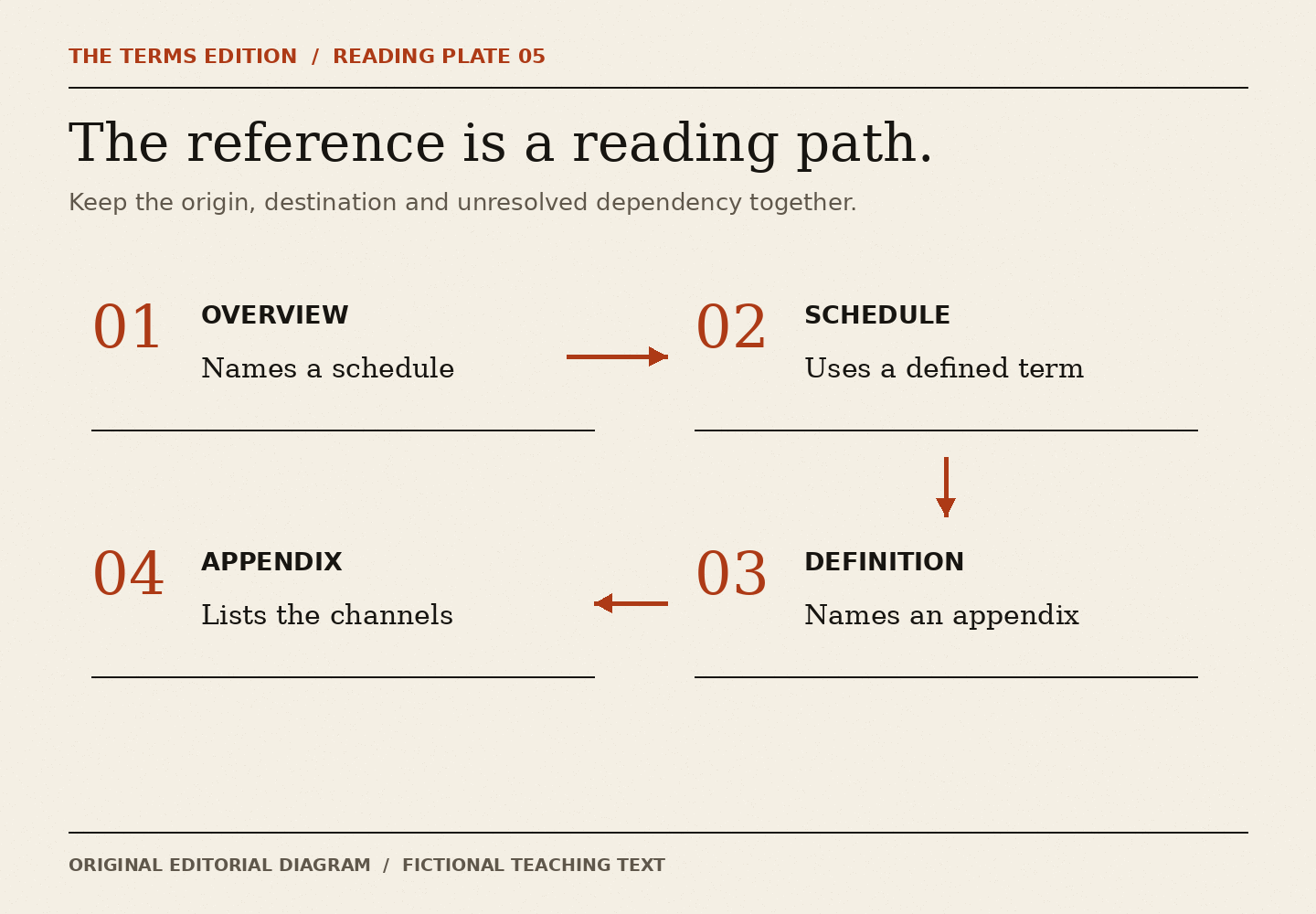
Imagine this invented three-step chain. The overview says, “Additional copies are subject to the document schedule.” The schedule says, “The listed condition applies to a Qualifying Request.” The definitions section says, “Qualifying Request means a request through the channels in Appendix C.” Appendix C then lists the channels.
The reading path is overview, schedule, definition, appendix. Each step adds a different kind of information. If you stop at the schedule, you have not yet understood the defined phrase. If you jump directly to the appendix, you may lose the condition that made the channel list relevant.
A compact chain note can use arrows between document locations, with a few words explaining what each contributes. Do not copy large passages merely to make the note look complete. The goal is a retraceable path. Keep the complete documents available separately when appropriate.
Notice when the trail changes documents
A reference within one file is different from a reference to another document. The second introduces an identity question: which version of the destination is intended? A link may open the current file while the originating document is older. A printed reference may name a schedule without supplying a date. The relationship needs checking.
Record the destination’s title and date labels when the trail crosses a document boundary. If the link redirects, note the page you actually reached. Do not silently replace a missing destination with a similarly named result from a search engine. A plausible substitute remains a possible match until the relationship is established.
A website’s terms of use, privacy policy, product overview, and cardholder agreement can sit beside one another in a footer. Their proximity does not make them interchangeable. Follow the specific reference rather than selecting whichever legal-looking document is easiest to open.
Broken references produce specific questions
A broken link does not tell you that the underlying condition disappeared. A missing appendix does not mean there are no restrictions. An unclear “see above” does not authorize selecting the nearest favorable paragraph. These are defects or limits in the copy available to you, and your notes should describe them as such.
A useful question identifies the origin: “The paragraph under Document Requests refers to Appendix C, but the supplied file ends at Appendix B. Where can I obtain the referenced appendix for this version?” This is easier to answer than “Your document is confusing,” and it does not accuse anyone of wrongdoing.
If several links fail, avoid opening random mirrors that ask for personal information or credentials. Stay with verified official sources for the document. This publication is not a download portal for account-specific terms.
Know when the chain is complete enough
A reference chain is complete for a reading question when you have located the conditions needed to understand that claim, not when you have read every linked document on the internet. A link to a general resource may be background rather than an incorporated condition. Read the wording that introduces it and record the difference.
You may still finish with uncertainty. The destination may use an undefined word, conflict with another passage, or depend on a program identity you have not established. Mark that remaining gap at the end of the chain. Do not hide it by checking a box called “all links opened.” Opening is an action; understanding the relationship is a result.
Before sharing your summary, trace backward from the destination to the original sentence. Ask whether your summary still includes the condition that sent you on the journey. If it does, the footnote has done its job: it has kept the claim attached to the information that gives it a usable meaning.
Sources & reading limits
Sources checked October 14, 2026. The reading method and fictional teaching passages are original editorial work. Public context does not establish the conditions of a particular account or program.
- Corpay PayCard product overview — Public payroll product context and referral to the cardholder agreement. Promotional timing and pricing claims are not generalized.