In this article
A dense paragraph can produce a broad reaction: “I do not understand this.” That reaction is reasonable, but it gives the person answering little guidance. A better question identifies the passage, the relationship you are trying to understand, and the missing piece. It does not require you to interpret the entire document first.
The CFPB’s prepaid-card resources provide general educational background. For a question about a particular program’s wording, the relevant official document and appropriate official source remain important. This article teaches question design; it does not provide account support, a complaint strategy, or legal advice.
Start with the decision the sentence is blocking
Ask yourself what you are trying to understand in the text. Is the uncertainty about which document applies, what a defined term includes, when a condition is met, or where an amount is stated? Name one reading problem. A question that asks about every feature at once is likely to receive an equally broad answer.
Do not start by drafting an argument. You may eventually need a specialist’s interpretation, but the first reading question is often factual: where is the referenced schedule, which version is intended, or what section defines the phrase? Those questions can resolve confusion without requiring a claim about rights or performance.
Use a fictional paragraph as a workshop
Here is a fictional teaching passage, not provider wording: “Eligible readers may request supported copies through the channels in the current schedule, except where an alternate process is specified.” The sentence contains at least five open points: eligible readers, supported copies, listed channels, current schedule, and alternate process.
A broad question is, “Can I get copies?” It discards the paragraph’s structure. A better first question is, “Which document title and version is the current schedule referenced in this paragraph?” Once the schedule is located, it may answer the channel and supported-copy questions. One well-chosen question can remove several downstream gaps.
If the schedule is already identified, the next question might concern a definition: “Where does this document define eligible readers for this section?” The best order follows dependencies. You cannot interpret a schedule you have not yet identified, and you should not assume eligibility merely because you can open a public page.
The four-part question frame
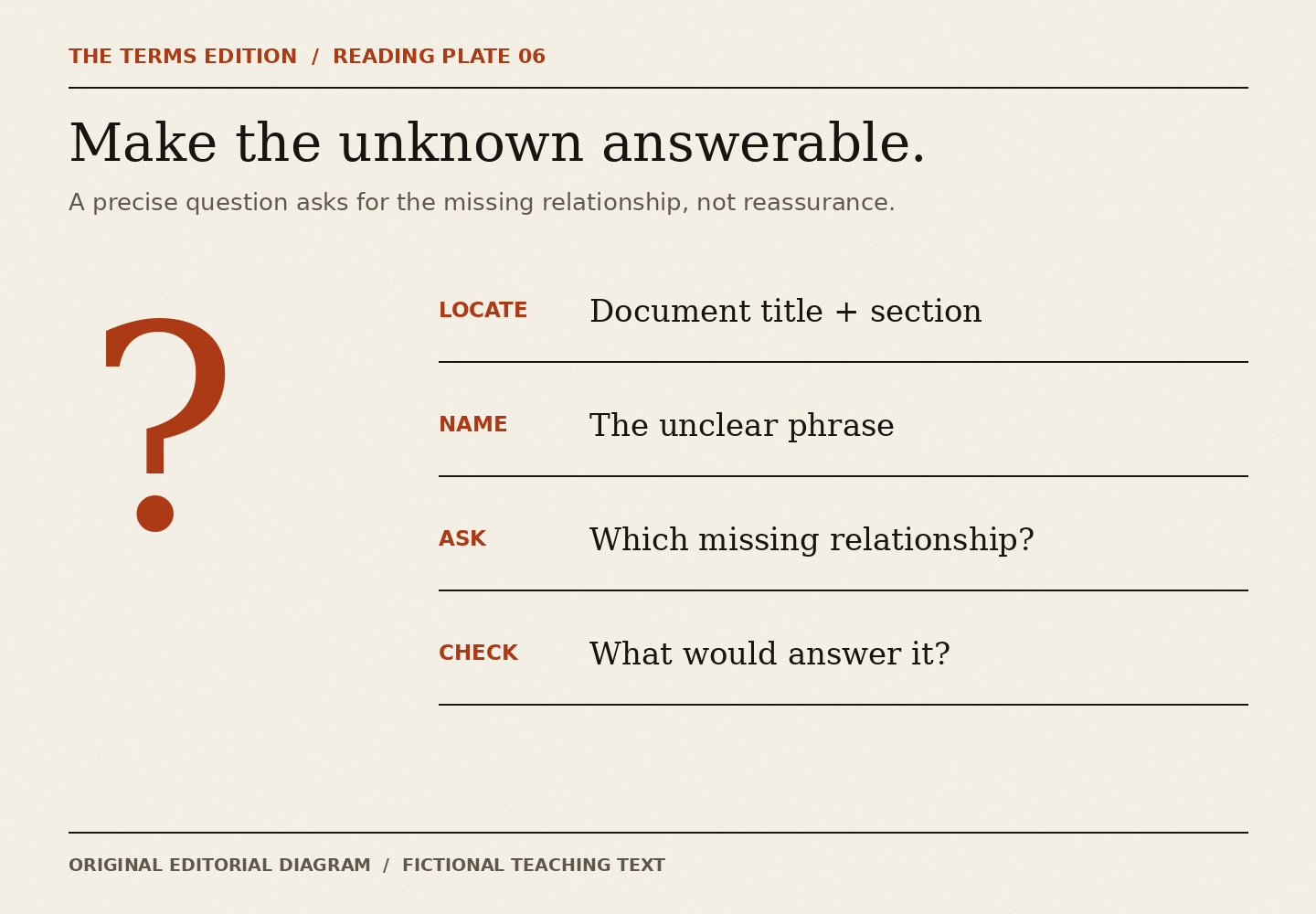
A focused question has a source locator, a short description of the unclear wording, the specific missing relationship, and a requested form of answer. For example: “In the identified guide’s Document Copies section, the paragraph refers to an alternate process. Which section describes that process for the named program?”
The requested answer is a section or document reference, not a general reassurance. This makes it easier to check whether a reply resolves the question. “Everything should be fine” may be friendly, but it does not identify the alternate process. A reference can be followed and read in context.
Keep quotations short and exact when you use them. Do not edit a conditional word out of the phrase you are asking about. If you paraphrase, say so. The recipient should not need to guess which words came from the document and which are your interpretation.
Remove assumptions from the question
“Why is this service always free?” assumes both universality and a price conclusion. A document-reading question would instead ask where the amount and any waiver conditions are stated for the described event. “When will this definitely happen?” assumes certainty. A better question asks what condition the sentence describes and whether the source states a period.
This is not a demand to sound timid. It is a way to keep the question answerable. An unsupported premise can pull the response toward correcting the premise rather than supplying the information you need.
Also remove unrelated personal detail. You can often ask about a document title, section, or definition without providing balances, payroll records, or credentials. If an official process needs account-specific information, follow that process separately. Do not send sensitive records to a publication because its article helped you phrase the question.
Read the answer against the original gap
When a reply arrives, compare it with the question you asked. Did it identify a document? Explain a term? State a condition? Or did it describe a general feature without resolving the missing relationship? An answer can be accurate and still not answer your specific question.
Record the reply’s source and scope in your own appropriate notes. If it names a document, obtain that document through the official route and inspect the relevant passage. If it introduces another condition, preserve that condition rather than treating the reply as an unconditional conclusion.
Do not keep asking the same broad question in different words. State the remaining gap precisely: “That identifies the service, but I still cannot locate the schedule version referenced by the paragraph.” This helps a legitimate clarification move forward.
End with a question that can close
A good question has an observable completion point. You receive the named appendix, locate the definition, or learn which version the source intends. The answer may then create a new question, but the original one should not remain a vague cloud.
For the fictional paragraph, the first completion point is an identified schedule with a source and version. That does not establish every condition or recommend using a feature. It gives the next reading step a reliable foundation.
The final discipline is to keep the question smaller than the decision you hope to make later. Document literacy is cumulative: identity, meaning, context, and uncertainty become clearer one passage at a time. An answerable question is valuable because it improves that evidence, not because it promises that every uncertainty will disappear.
Sources & reading limits
Sources checked October 14, 2026. The reading method and fictional teaching passages are original editorial work. Public context does not establish the conditions of a particular account or program.
- CFPB: Prepaid cards and other prepaid accounts — General vocabulary and educational context. Does not replace the relevant program documents.