In this article
A feature sounds useful. A search result looks official. A familiar card name appears in the heading. Those three observations can still leave the most important reading question unanswered: does this document describe the arrangement you are trying to understand? Before interpreting a paragraph, establish what kind of document it is, whose program it describes, and which version you have. A careful reading of the wrong document can produce a very confident mistake.
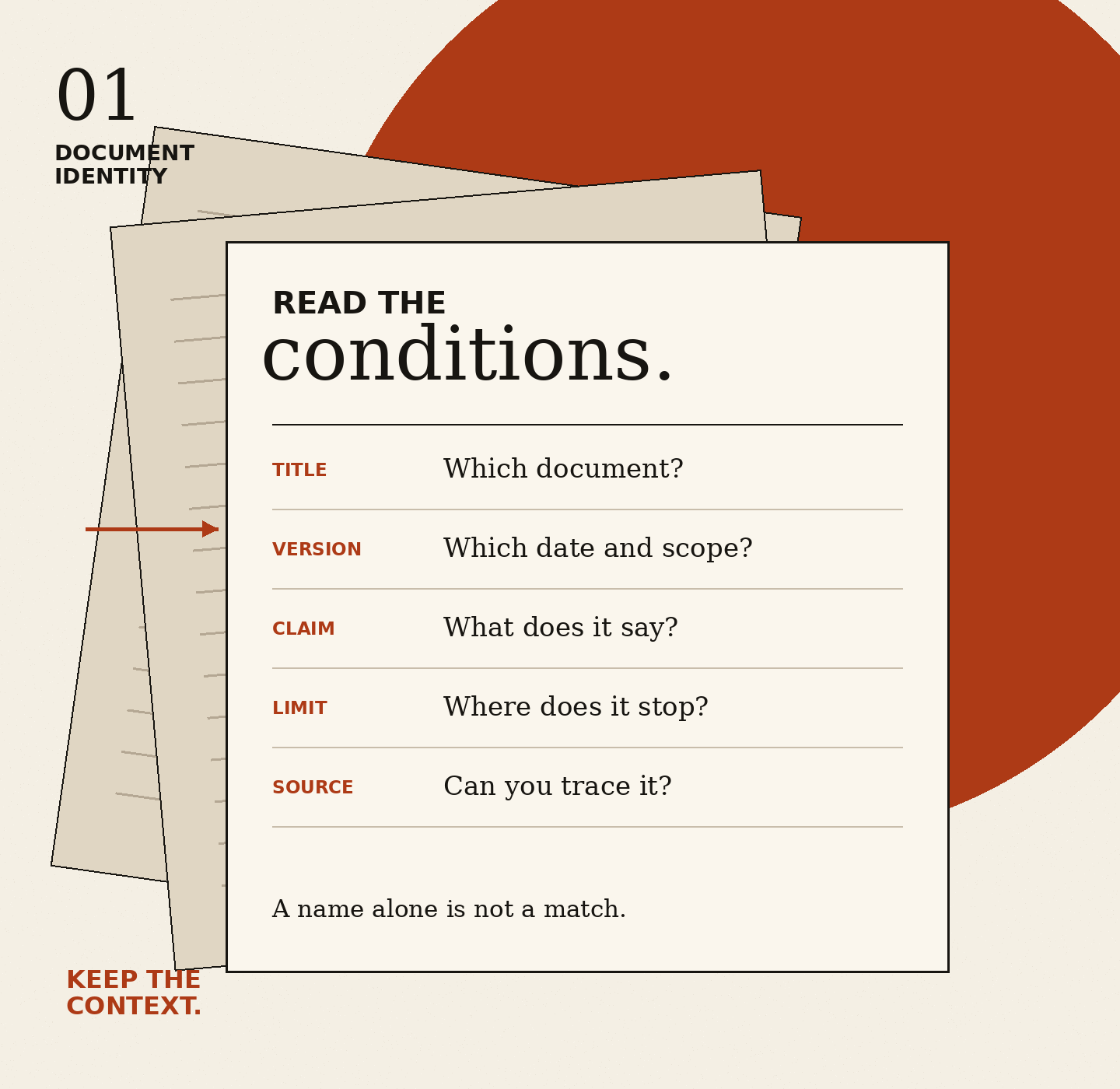
This is a guide to building a document identity record. It does not determine which agreement legally governs an account, interpret contractual rights, or recommend a card. The outcome is smaller and more practical: a reader can distinguish an identified source from an attractive but unverified match, and can explain exactly what remains uncertain.
A name is a starting point
Fintwist is now Corpay Prepaid, according to the provider’s public notice. Its public pages distinguish PayCard for payroll from FlexCard for business disbursements, including incentives and reimbursements. Those labels help organize a search. They do not establish that every document carrying a related name describes the same conditions.
A brand can appear on a product overview, a cardholder agreement, an employer handout, a privacy notice, and a website’s own terms of use. These documents answer different questions. A website-use policy may tell you about using a website while saying very little about a card feature. An employer handout may explain where to obtain materials without being the complete disclosure. A product page can describe a family of offerings without identifying an individual arrangement.
Treat each title as a claim about purpose, then inspect the body for evidence. Does it identify a specific product or program? Does it name an issuer or another responsible entity? Does it say who the intended reader is? Does it refer to another document for the conditions you want? You are looking for a coherent identity, not merely a recognizable logo.
The cover sheet method
Create a small cover sheet before making detailed notes. Record the document title exactly, the source location, the date you obtained it, any printed effective or revision date, the product or program name, and the organization named in the document. These are separate fields because they answer separate questions. The date you downloaded a file is not its effective date. A date in the filename is not automatically a revision notice. A copyright year in a footer may tell you little about the age of a specific condition.
If a field is absent, write “not shown.” Do not repair the document by guessing from a search result. If two dates appear, copy both with their labels. “Updated” and “effective” should not be merged into a single date called “current.” Your notes should preserve the distinction even before you understand its significance.
Keep the source location specific enough to revisit. A homepage address is weaker than the page from which you obtained the file. For a paper packet, note the packet title and where it was provided, without adding private account information. If a document was supplied through an authenticated account, keep it in your own appropriate storage; this publication does not need to receive it.
A fictional packet with three plausible matches
Consider this entirely fictional reading exercise. It does not reproduce any Corpay agreement. Morgan has three items: a page titled “Everyday Payroll Card Overview,” a PDF titled “Everyday Card Agreement, Program Q,” and a printed sheet titled “Getting Started at Cedar Workshop.” All three show the same invented product name. The overview describes online features; the agreement names Program Q; the printed sheet directs workers to a packet supplied during orientation.
Morgan initially labels all three “card terms.” That label hides the work each item can and cannot do. A better record calls the first a public product overview, the second an agreement with an identified program label, and the third employer instructions. Morgan then writes one unresolved question: “Is Program Q the program described in my orientation packet?” Until that identity is checked through an appropriate official source, the agreement is a possible match rather than a confirmed match.
Now suppose the agreement’s first page says “Revision B” and its last page says “Effective for newly issued Program Q cards from June 1.” Morgan has not learned whether the document applies to every existing card. The title alone did not reveal the scope of the effective statement. The cover sheet records the exact scope in a short note and leaves applicability unresolved.
This is not an exercise in distrusting everything. It is a way to prevent one fact from doing the work of several. An official source can be authentic while still being too broad, too old, or intended for a different audience to answer the present question.
Read the document’s own boundaries
After the cover sheet, inspect the introduction, definitions, headings, footnotes, and closing pages. These are often where a document explains its limits. A sentence may narrow the audience, identify a separate schedule, or say that another version applies to a particular program. Search can help locate words, but it cannot replace reading the surrounding paragraph and the destination of any cross-reference.
Keep three kinds of statements separate in your notes. Identity statements say what the document is. Scope statements say which people, products, activities, or periods it describes. Feature statements say something about a service. A feature statement does not resolve a missing identity statement. “Transfer available” is not evidence that the file is the agreement for your program.
Do not decide document precedence simply by choosing the longest file or the one with the newest-looking design. Nor should this magazine decide legal priority between conflicting documents. If a conflict matters, preserve both passages with their identifiers and ask the responsible official source which document and version should be used for that question.
A useful record can contain uncertainty
An identity record is not a certificate. It can say: title confirmed; source confirmed; revision stated; program match unresolved. That is more informative than a single green check labeled “verified.” Different facts have different evidence, and a later answer may resolve one while leaving another open.
Use a short confidence sentence rather than a score: “This is an official public overview; it does not identify my program.” Or: “This file was supplied in the program packet, but no effective date is visible.” These sentences describe the evidence without claiming more than it supports. They also help another reader understand why you paused.
The Disclosure Reading Map on the homepage follows this approach. It records categorical reading states and produces questions about missing context. Checking every category does not make a document applicable, prove that an interpretation is correct, or establish that a product is suitable. The tool cannot inspect the document; your selections are a record of your reading.
What to keep and what to leave out
For ordinary study notes, keep document labels, section names, page numbers, the relevant condition, and the unresolved question. You do not need a card number, balance, payroll record, identity document, or login credential to record how a sentence is structured. If those details appear in the source, avoid copying them into a general notebook or a message about document wording.
For a digital file, retain a complete copy when you are allowed to do so rather than only a cropped screenshot of the attractive sentence. A crop can remove the heading and footnote that make the sentence intelligible. If you also save a short excerpt, give it a location and a link back to the complete source. Your summary and the source should remain visibly different objects.
If you are sharing a question with an official contact, use that organization’s appropriate route and follow its instructions about what information is necessary. The publication’s corrections address is for articles on this website, not for submitting account records or obtaining a decision about an agreement.
Stop when the next question is clear
There is no prize for building an enormous document archive. The cover sheet is useful when it lets you find the source again, distinguish it from nearby documents, and state what evidence is missing. If you cannot establish the program match, reading another twenty pages may not resolve the central gap. A targeted question about identity can be more productive than more highlighting.
A finished reading note might say: “I located the official overview and a document labeled Program Q, Revision B. The overview does not identify my program, and the revision statement has a limited audience. Which document title and version should I use for this feature?” That question is specific without asserting a conclusion.
Once identity is sufficiently clear for your reading purpose, move on to the paragraph itself. Keep the cover sheet attached to the notes. When you return weeks later, it will remind you which claims were grounded in a source, which were your interpretation, and which were still waiting for an answer.
Sources & reading limits
Sources checked October 14, 2026. The reading method and fictional teaching passages are original editorial work. Public context does not establish the conditions of a particular account or program.
- Corpay Prepaid name-transition and public card overview — Name transition, broad product labels and explicit qualifications. No universal feature or account determination.
- Corpay PayCard product overview — Public payroll product context and referral to the cardholder agreement. Promotional timing and pricing claims are not generalized.
- Corpay FlexCard product overview — Public business-disbursement positioning, including incentives and reimbursements. Does not establish a particular program.