In this article
Two documents sit side by side. One looks newer. A paragraph has moved. A heading has changed. It is tempting to call the whole document “updated” and assume you know what that means. A version comparison should be more exact: which text changed, what kind of change is visible, and what cannot be concluded from the comparison alone?
The CFPB’s prepaid account agreement collection provides agreement files and supporting information for research. A public collection can help locate material; it does not establish which version applies to a particular reader. This article is about comparing documents you are authorized to read, not deciding legal effect or whether a notice was adequate.
Establish that the pair is comparable
Before comparing words, compare identities. Do the files name the same product, program, issuer, and audience? Are they both agreements, or is one an overview and the other a schedule? Are they complete copies? A difference between two unrelated documents is not necessarily a revision.
Make a two-column identity note outside the text comparison. Record the title, visible date labels, source, and scope for each. If one identity field differs, keep it visible. The files may still be worth comparing, but the comparison must be described accurately: “two related program documents,” for example, rather than “old and new versions” when that relationship is unconfirmed.
The word “latest” deserves particular care. A recently downloaded file may contain older text. A search engine may show a recent crawl date. A file modified on your computer may simply have been copied. Only describe a date according to the evidence attached to it.
Align meaning before aligning pages
Pagination changes can make a simple revision look extensive. A larger font, a new cover, or a different page size shifts every section. Compare by heading and subject before comparing page number. Create a small correspondence list: the old section called “Document Copies” appears under “Information Requests” in the second file, for example.
Use a text comparison tool as a locator, not a judge. It can identify changed characters but cannot tell you whether two differently worded sentences mean the same thing. It may also miss meaningful differences in a table, an image, or a footnote extracted in the wrong order. Inspect the original layout around every change that matters to your question.
If you use an online comparison service, consider what you would be uploading. This publication does not ask you to upload agreements or account materials. For a reading exercise, fictional text or public documents are enough. Private documents belong only in handling arrangements you have chosen and are authorized to use.
A fictional change with three layers
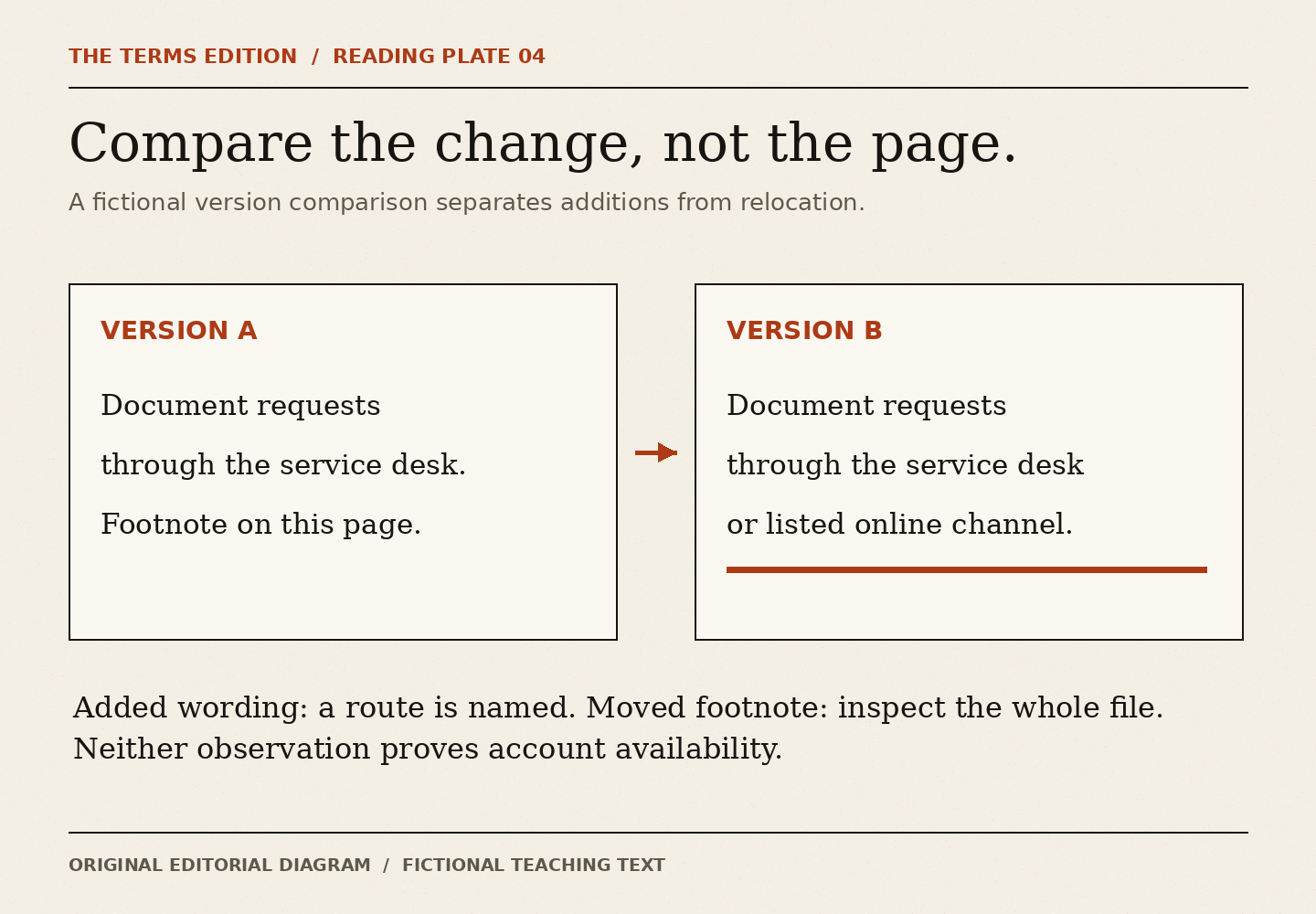
Consider an invented Version A sentence: “Document requests can be made through the service desk.” Version B says: “Document requests can be made through the service desk or the listed online channel.” The visible change adds a route in the sentence. That is an observation about the text. It is not proof that the online channel is active for a particular account or that every request type is supported there.
Now suppose Version B also changes the heading from “Copies” to “Records,” while the paragraph remains otherwise identical. The new heading may broaden or simply rename the section; the wording alone may not settle that. Record the heading change separately from the channel addition. Different changes deserve different questions.
Finally, Version B moves a footnote onto the next page. A text-only comparison reports it as deleted and added. Looking at the full pages reveals that the words are unchanged. That is a relocation, not a substantive deletion. A careful comparison reduces noise rather than amplifying it.
Give changes descriptive labels
Use labels that say what you observed: added text, removed text, substituted wording, relocated passage, changed reference, changed identity, or unclear extraction. These labels do not decide the legal or practical importance of the change. They keep the first pass honest.
A second column can describe the reading question. Added channel text raises the question of scope and applicability. A changed definition may affect several later sections. A changed cross-reference requires checking the new destination. A corrected spelling may not require further analysis. Do not force all changes into a ranking system when the evidence is incomplete.
The most useful comparisons often have very few highlighted items. A page covered in color does not distinguish typography from a changed condition. Reserve a separate mark for uncertainty so that a reader can tell the difference between a definite textual change and a possible extraction error.
Follow the consequences within the document
When a definition changes, search for the term’s later uses. When a section number changes, inspect incoming references. When a table row changes, check the notes attached to that row. This is a dependency review: the purpose is to find places where the changed text participates in another statement.
Do not assume every dependent passage changed meaning. The later wording may already contain a narrower condition or may use the term in a different context. Your comparison should point to the relevant passages and explain the possible connection without asserting an effect you have not established.
A useful note might read: “The definition of Service Request now names an additional channel. The confirmation section uses that defined term. Applicability and effective scope need confirmation.” This is more informative than “confirmations improved,” which introduces an evaluation and implies an operational result.
Preserve the unresolved relationship
Sometimes two official documents disagree and neither clearly supersedes the other. Keep the disagreement visible. Record both locations and ask which title and version should be used for the particular question. Choosing the more favorable sentence, the later-looking page, or the document with the larger logo is not a reliable method.
Do not discard the earlier copy merely because you obtained a newer one. If you keep both, label them clearly so that an old excerpt does not reenter your notes as current. Retention decisions for private documents depend on your circumstances; this article does not prescribe a legal retention period.
Write a comparison note another reader can audit
End with a short statement of scope: which two files were compared, which sections were examined, and what was not checked. Then list the specific changes relevant to your question, separating direct observations from your interpretations. Include the source and date labels so that the comparison can be repeated.
For the fictional pair, the conclusion is modest: “The second document adds a listed online channel to the request sentence. A heading changed and a footnote moved. We have not established the document’s applicability or the operation of that channel.” That is a successful comparison. It explains what the evidence shows without turning a word change into a promise.
Sources & reading limits
Sources checked October 14, 2026. The reading method and fictional teaching passages are original editorial work. Public context does not establish the conditions of a particular account or program.
- CFPB: Prepaid account agreements — Public agreement files and supporting information as a research resource. Does not establish individual applicability.