In this article
A fee table invites the eye toward the amount column. Numbers are easy to compare, circle, and remember. But a number without its trigger and surrounding conditions is an incomplete reading. The useful unit is the entire relationship: what event the row describes, what charge is stated for that event, and what changes the result. This article teaches a way to read that relationship without calculating anyone’s costs or inventing a fee schedule.
The CFPB’s explanation of payroll-card fees distinguishes the short-form and long-form disclosures and the cardholder agreement. Use the actual materials for the relevant program; this magazine does not supply their amounts. The method below is original editorial guidance, and its sample wording is fictional.
Read across before reading down
Suppose a fictional teaching row says: “Paper history request: amount shown in the schedule; reduced charge when requested through the designated channel; separate delivery services are excluded.” No dollar amount is provided because the point is the grammar. Reading only “reduced charge” loses both the condition and the exclusion. Reading only the amount loses the possibility that a specified condition changes it.
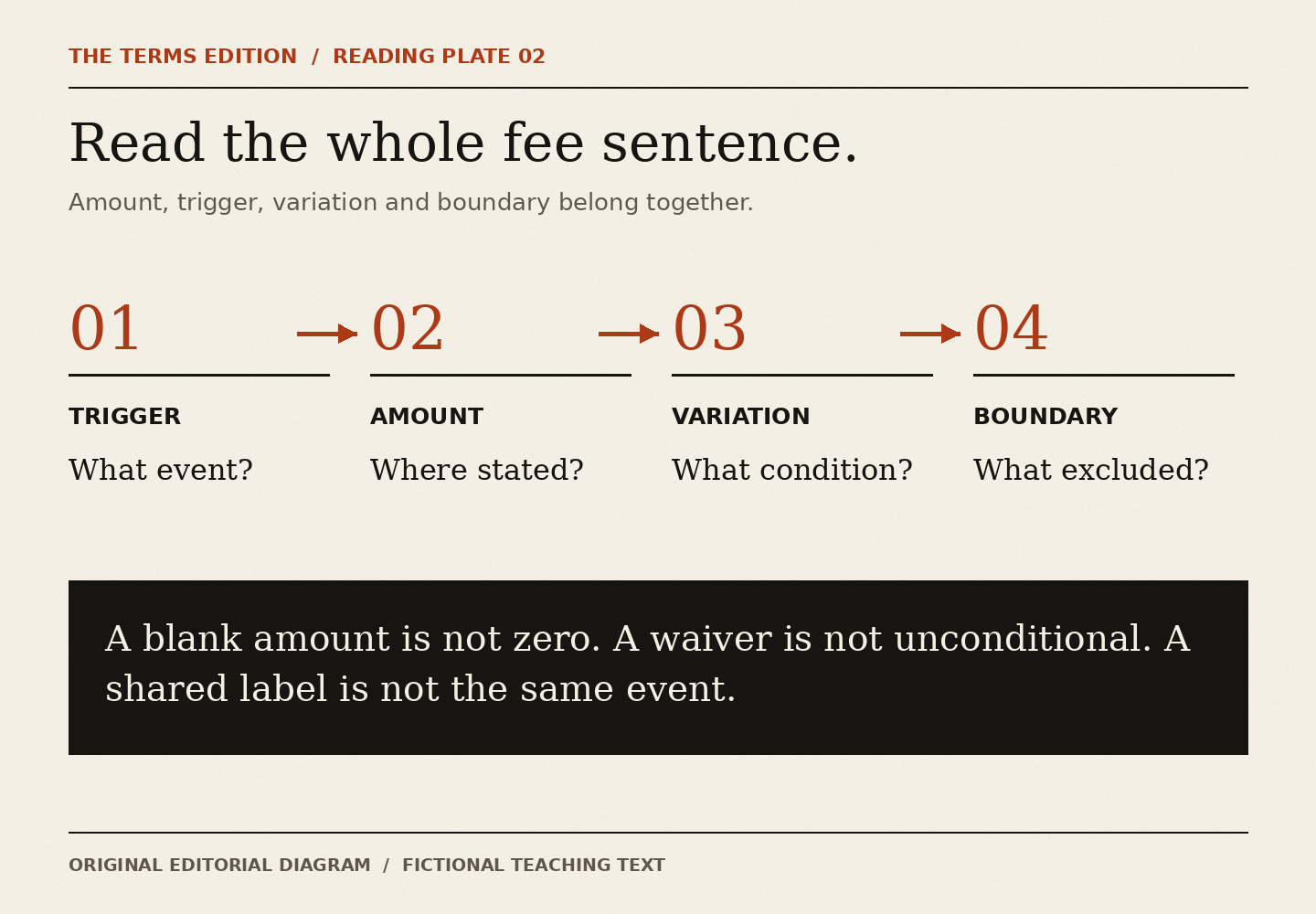
Take the row horizontally. First name the event: a paper history request. Next identify where the amount is stated. Then preserve the qualifying channel. Finally note the excluded delivery services. A vertical scan comparing amounts across rows is useful only after each row has been read this way. Otherwise you may compare unlike activities while believing you are comparing prices.
A blank cell requires attention too. It may be a layout issue, a heading applying to several rows, or missing information in the copy you have. It should not become a zero in your notes. Write “amount not located in this view” until you can read the complete row and its context.
Separate trigger, amount, variation, and boundary
A four-part annotation is usually enough. “Trigger” is the event or condition that the text says can give rise to a charge. “Amount” is the stated figure or method of calculating it. “Variation” records an explicit reduction, waiver, tier, or other conditional change. “Boundary” preserves what the statement does not cover. These are reading categories, not legal classifications.
Do not assume every row contains all four parts. Sometimes the amount is clear but the trigger uses an unfamiliar defined term. Sometimes the trigger is simple but a footnote describes the variation. Sometimes the document explicitly says a third party may impose a separate charge. The annotation should make those differences visible rather than forcing every row into a tidy answer.
The CFPB’s official interpretation concerning prepaid disclosures discusses fee amounts and conditions for imposing, waiving, or reducing them. That is useful context for reading related text together. This article does not assess whether any disclosure complies with a rule or whether a charge is permitted.
Two fictional rows that should not be merged
Consider two invented rows in an educational worksheet. Row A concerns “a copy requested through the automated document service.” Row B concerns “a copy prepared through a staff-assisted request.” Both contain the word “copy,” but the channel is part of the described event. A reader who creates one note called “copy fee” has thrown away a distinction before knowing whether it matters.
The correct next step is not to recommend one channel. It is to preserve the distinction in the comparison. Write the complete label for each row, the location of its amount, and any associated note. If the phrase “automated document service” is not explained, flag the phrase. Do not substitute the name of an app merely because it seems likely.
Now add a fictional footnote: “A reduction applies to one qualifying request within the defined period.” The important words include “one,” “qualifying,” and “defined period.” Removing any of them changes the proposition. Your note needs the period definition and the qualification, not just a reminder that a reduction exists.
A waiver is conditional information
Readers sometimes turn “waived if” into “free.” This is a compression error. A waiver statement has at least two parts: the charge being discussed and the condition for the waiver. It may also describe when the condition is assessed or what happens if it is no longer met. Keep these parts attached when you summarize.
An honest summary might read, “The document describes a waiver for this row when the stated condition is met; I have not established whether that condition applies.” That sentence is less convenient than “no fee,” but it preserves the question you actually need answered. It also avoids treating a reading exercise as an account assessment.
Do not create your own waiver by reasoning that the service seems cheap to provide, that a similar product offers it, or that a friend was not charged. Those observations do not replace the relevant disclosure. A past experience may suggest a question, but it does not define the document’s terms.
Distinguish absence from an explicit statement
There are several different reading outcomes: the document explicitly states no charge for the described event; the amount appears elsewhere; the row is absent; the copy is incomplete; or the wording is ambiguous. These outcomes should not share one label. “I did not find a fee” reports a search result. “The identified row states no charge” reports a document statement with a defined scope.
Search for synonyms only as a discovery aid. A document might organize charges by service, channel, or event rather than the word you expected. Read headings and adjacent rows, and follow references to an additional schedule. If the search still produces no answer, make the absence precise: “I checked the fee schedule and the section named in the overview but did not locate the amount for this described event.”
Leave with an annotated row
The useful artifact is one row that another reader can trace: document identifier, section or page, event label, amount location, variation wording, exclusion, and remaining question. You do not need to copy the entire fee schedule or calculate a monthly total to learn how to read it.
Before relying on your summary, compare it with the source once more. Have you dropped a frequency word? Replaced a specific channel with a general one? Treated a third-party charge as part of the provider’s statement? Turned an unresolved amount into zero? These are editorial checks on the summary, not an assurance about the underlying product.
If the annotated row still leaves a material condition unclear, carry the exact wording and location into a focused question for an appropriate official source. A better question often begins with the event being described, rather than “How much does the card cost?” The narrower wording makes it easier to obtain an answer that matches the sentence you are reading.
Sources & reading limits
Sources checked October 14, 2026. The reading method and fictional teaching passages are original editorial work. Public context does not establish the conditions of a particular account or program.
- CFPB: Are there fees to use a payroll card? — Context for reading short-form and long-form disclosures together with the agreement. No legal-rights conclusion is drawn.
- CFPB: Official interpretation, prepaid-account requirements — Limited contextual support for reading fee amounts with their conditions; not a compliance assessment.